

Celebrity Graffiti: The Dark Empath Does Not Exist
on the word I used to describe myself twisted up in a journal title

The Marks Some Leave Upon Us - gritty witty blind item memoirs on celebrity, narcissistic abuse, public image, cultural obsession, & thriving after trauma. Powerful healing is found in telling our stories.
© I have called myself an empath for most of my adult life, the way other people call themselves early risers or procrastinators. It was never a brand though, it was a plain report about how I am built: the fact that I walk into a room and feel the vibe in it before anyone has admitted there is a vibe; that other people’s pain arrives in my body before it arrives in my thinking. This is not a superpower or a costume. To live this way is to keep the body as a house with no walls, and to spend a great deal of your life explaining to people why you felt the chaos before it started.
Then, in 2021, a phrase surfaced in a personality journal and moved across the internet with the slick speed making that cruel phrase sound peer-reviewed: the dark empath. A creature said to be high in empathy and high in the dark-triad traits at once, sensitive and predatory in the same skin. Any true empath knows this is impossible. It is just reactive abuse being twisted into a thing that shames them as it steals a part of their identity. It is DARVO (Deny, Attack, Reverse Victim and Offender) at a level that gaslights to the core. All that you think is good about you is in fact evil, and you, dear empath, are the villain.
The paper was one study. A single sample of fewer than a thousand people, heavy on students, which is the kind of sample other researchers will tell you not to build a type on. Evidence was thin. But thin research travels fast when the conclusion is flattering to the wrong people, and this one was very flattering to the wrong people. Academic research can be useful, but one small study does not get to discover a new goblin and hand it a LinkedIn profile.
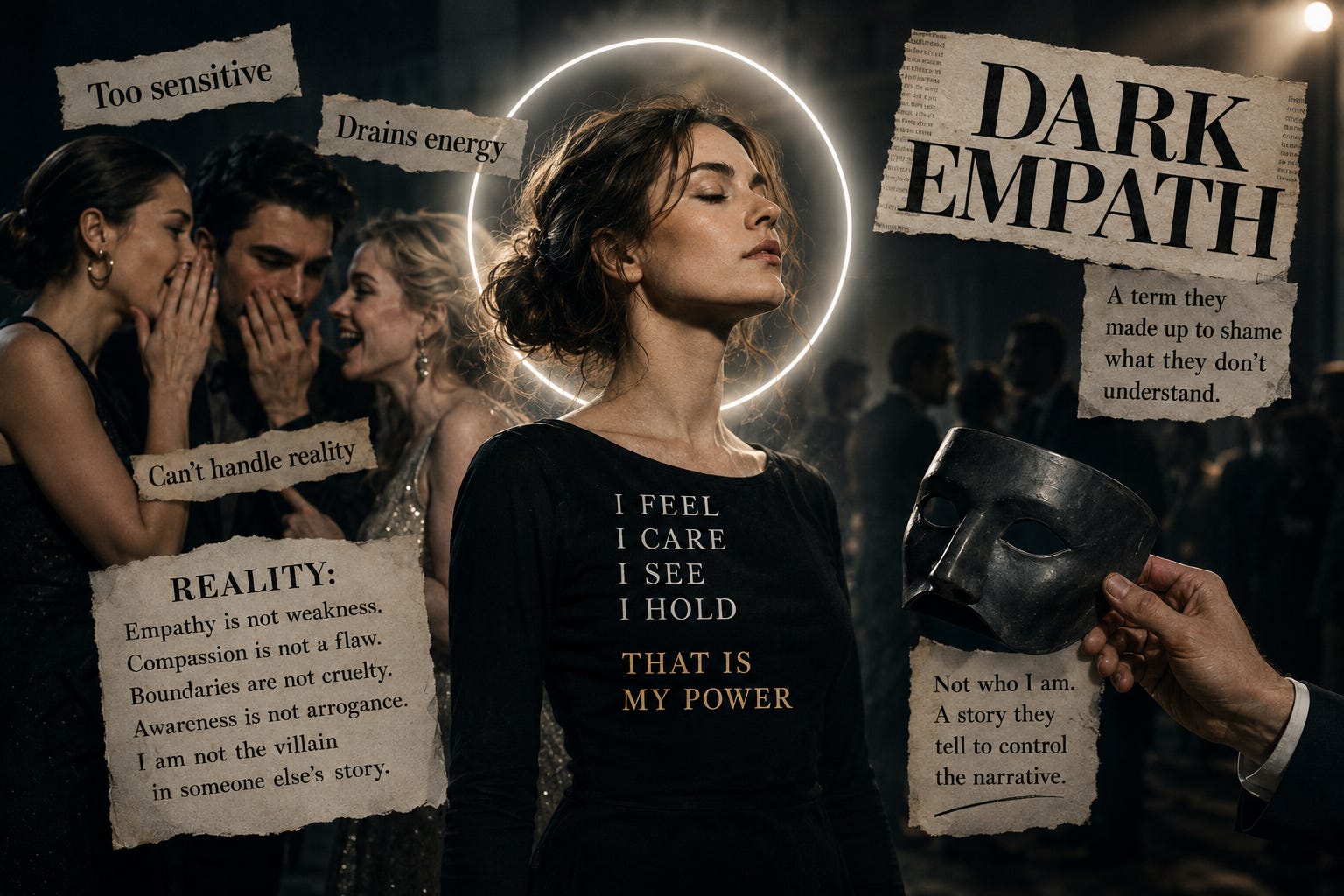
For me, the timing of this new goblin was not an accident. I had been calling certain powerful people in a celebrity cult what they were - malignant narcissists - out loud, and in a voice they did not control. Right as I was moving toward doctoral work, where a formal academic citation would land harder on me than a mere online accusation, this tidy piece of scientific language arrived. It took the one word I used for myself and handed it directly to them.
I am not telling you they commissioned the study. I am telling you what it is like to watch your own vocabulary get repossessed by monsters and be unable to prove it. When you call a predator a predator, the gears turn. Suddenly the sensitive one is the suspect, the one who feels too much is the one to fear, and the empath is the danger in the room. I am certain this celebrity cult helped the term trend, using slick images to illustrate a supposed dark evil inside some of the most compassionate people on earth. But the dark empath is just DARVO with a footnote. It does not need to be true; it only needs to trend to protect them.
The Psychology Manual Doesn’t Want It
The clinical facts, however, are on my side. The dark empath is not a diagnosis. It is not in the DSM-5, and you cannot be assessed for it any more than you can be assessed as a Slytherin. What clinicians will tell you, when you ask, is that the thing the internet is calling a dark empath is a person they already had a word for: someone high in the dark-triad traits who happens to have good social skills. Empathy simply cannot live in the same room as predation. What these public figures are calling empathy is just pattern recognition with bad intentions.
The DSM-5 doesn’t know her; it has left her on read. As sociologist and writer Candace Ranee put it, “Dark empath is NOT a valid clinical term or a diagnosis.”
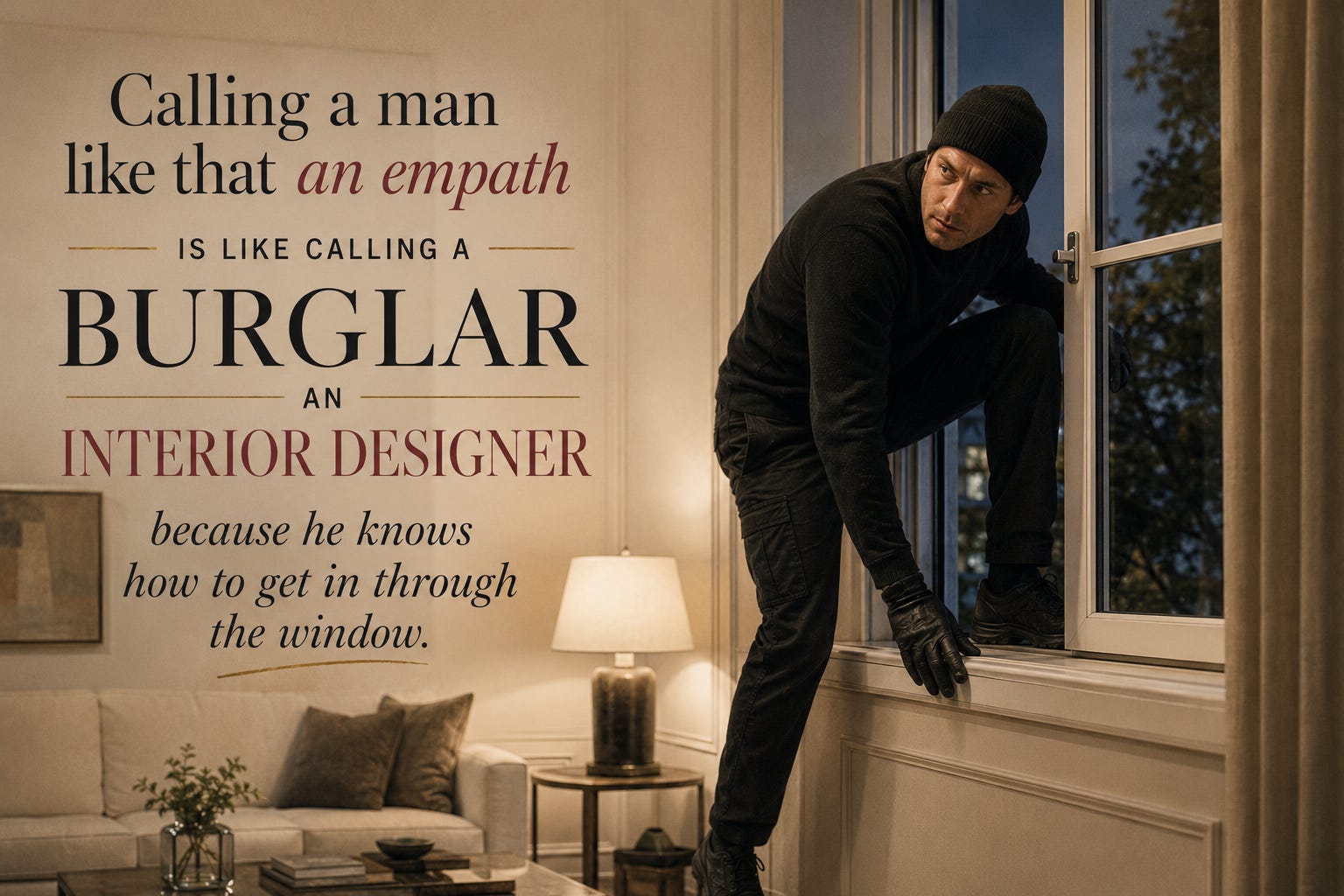
The study’s own details give the game away, resting on the split between cognitive empathy (the intellectual ability to work out what you are feeling) and affective empathy (the capacity to actually feel it with you). A manipulator can have the first without a trace of the second. He can know exactly where you are tender and remember your wounds. That is not empathy; that is reconnaissance. He is casing the joint. Calling a narcissist an empath is like calling a burglar an interior designer because he knows how to get in through the window.
The Weaponization of the Word “Empath”
This is where the feminist history clicks into place, because it is the same trick wearing a new coat. For centuries the woman who read the danger first was the problem. Her perception was hysteria, her anger was instability, her intuition was paranoia, her boundaries were cruelty, her memory of what happened was drama. The move was never to argue with what she saw. The move was to reclassify the seeing. The dark empath is that maneuver updated for the algorithm. It takes the one capacity a woman like me was told all my life was my best quality, the ability to feel another person’s pain as my own, and asks me to wonder whether it is secretly evil.
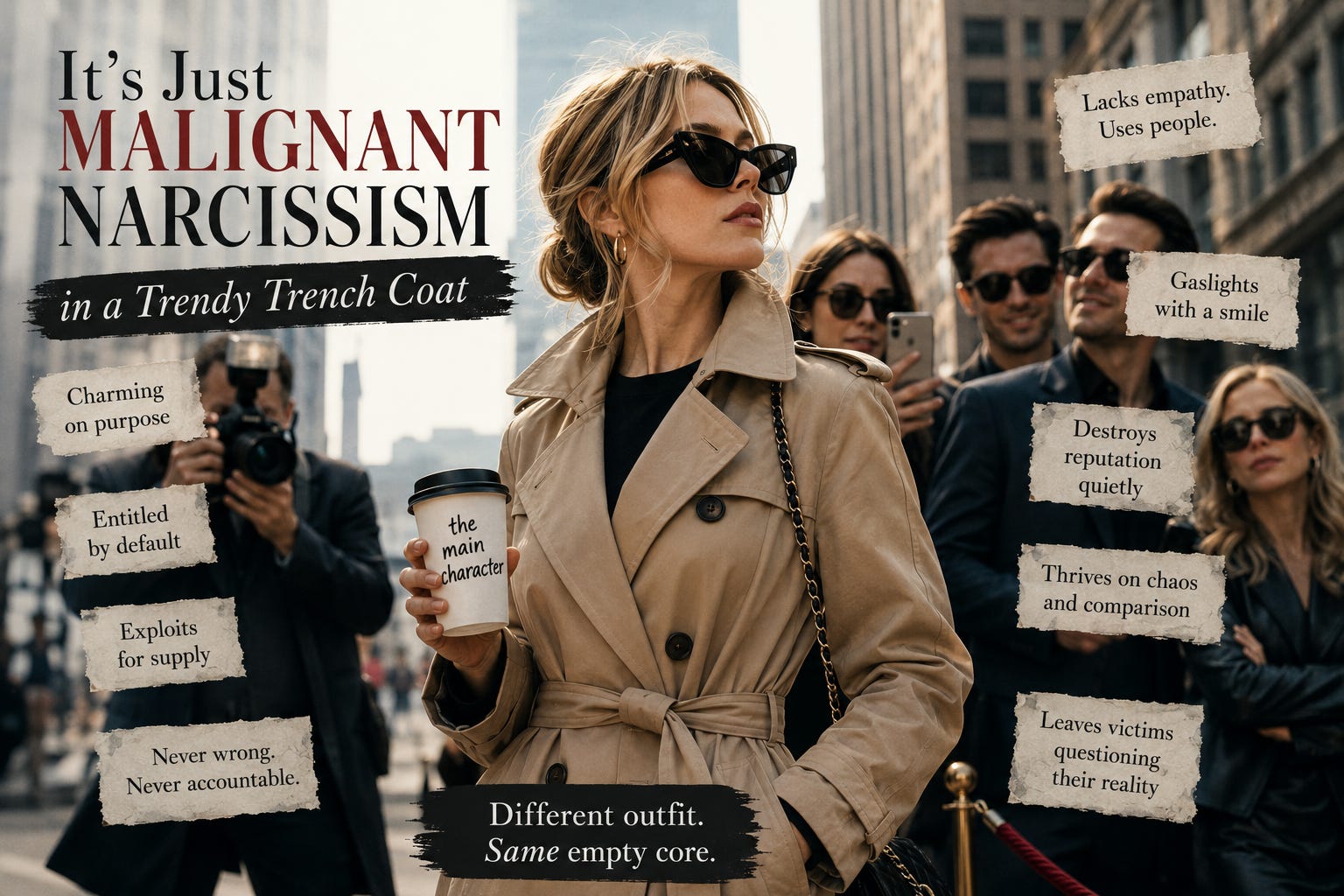
It’s Just Malignant Narcissism in a Trendy Trench Coat, Pretending It Went to Grad School. A narcissist can study your feelings but he cannot feel them. The whole grief of dealing with one is discovering, usually too late, that the warmth you thought you were standing in was a very good drawing of warmth. A mirror angled to catch the light.
When someone puts “dark” in front of “empath” and sells it back to you as science, understand what is actually being purchased. Not a new type of person, but deep cover for a predator. It is a way for the narcissist to borrow the coat of the empath they are torturing. This celebrity cult jumped at a chance - commissioned or not - to change the dictionary so I would stop trusting my own identity, so I would look at a word I had for who I was and flinch.
The dark empath does not exist. Malignant narcissists would simply love it to because it makes the reversal they try to inflict on victims who are usually empaths, so much cleaner. A thin little study gave them the citation to try. It never should have.
A narcissist will steal your pain, your language, your friends, your story, and then ask if anyone has seen his empathy because he left it somewhere near the ring light. These people do not need a new diagnosis. They need consequences, a locked group chat, and fewer opportunities to discover themselves being falsely vindicated on TikTok. ©

The marks some leave upon us are not always visible.
References:
The study the term comes from: Heym, N., Kibowski, F., Bloxsom, C. A. J., Blanchard, A., Harper, A., Wallace, L., Firth, J., & Sumich, A. (2021). “The Dark Empath: Characterising dark traits in the presence of empathy.” Personality and Individual Differences, 169, 110172. Nottingham Trent University. One preliminary study, described by its own authors as a “novel construct,” is the entire foundation the trend rests on. Very Thin. Debunked.
On the dark empath not being a clinical diagnosis: Fiorini, C., LISW-CP. “Dark Empath: Meaning, Traits, Signs, and What a Therapist Wants You to Know.” LifeStance Health. States plainly that the term is a descriptive construct, not a diagnosis, and does not appear in the DSM-5.
On the lack of professional consensus: “What Is a Dark Empath?” MentalHealth.com. Notes that dark empathy remains a debated construct, with no consensus on whether it is a distinct psychological profile or simply a descriptive recombination of traits psychology already measures, the Dark Triad, emotional intelligence, and attachment.
A sociologist’s public criticism of the trend: Ranee, C. “The ‘Dark Empath’: A Dangerous Trend Glorifying Sociopaths.” Points out that the source is a preliminary study, that “dark empath” is not a clinical term, and that the label risks glamorizing the same predatory behavior clinicians already have names for.
They wanted to change the dictionary so I'd stop trusting my own definitions. What's a word that's been used against you, that you've decided to keep anyway?